Ergonomics Essential Guide: Making Handling and Lifting Safer and Easier
Whether you are a supply chain manager, a warehouse manager, a logistics professional, a safety professional, or an employee whose work involves manual handling, ergonomics are crucial in your daily life.
Ergonomics refers to the process of designing workplaces, systems, products, and equipment to suit their users optimally. Why is this important?
Benefits of Ergonomics
Ergonomics are crucial because performing a job using the wrong posture, extreme temperatures, or repeated movement can affect one’s musculoskeletal system and cause injuries ranging from mild to severe, permanent disabilities.
The main advantages of ergonomics include:
Increased savings: ergonomics support a safer working environment, meaning fewer injuries to your workforce. As a result, you get fewer workers’ compensation claims. Here are some compensation figures for Ireland:
- An elbow injury is compensated at between €9,000 and €81,900
- € 27,000 and €70,000 for a wrist injury
- €21, 200 and €56,400 for a thumb
- €14, 800 and € 92,000 for a back injury
- €14,000 and € 89,000 for knee injuries
Note that these costs depend on the severity of the injury and can include other indirect costs that push the costs higher. Ergonomics can help prevent workplace injuries and, by extension, workman’s compensation claims.
Healthier Employees: workplace injuries will cause pain or discomfort to the affected employee. Implementing ergonomics minimizes the risk factors that lead to injuries.
Increased productivity: ergonomics lower employees’ risk of injury. This keeps them healthy, which ensures productivity.
Increased morale: Ergonomics is one way employers show concern for their employees. Employees who feel cared for exhibit higher motivation levels, have more job satisfaction and tend to stick with such employers for longer. High morale leads to increased productivity. Similarly, a low turnover saves a company from recurring hiring costs.
So, how can companies manage ergonomics?
How To Use Ergonomics for Handling and Lifting
So, what are some ways businesses can use ergonomics to create a safer, more productive workplace? Here are some pointers.
Moving Equipment
Some jobs involve significant ferrying of bulky items. Pulling, pushing, or carrying heavy items repeatedly can cause a lot of stress to the back, shoulders, knees, and upper arms. Similarly, using the wrong technique or posture can lead to injury.
For forward-thinking businesses, investing in high-quality, durable moving equipment can ensure employees’ safety at work and optimize productivity and efficiency.
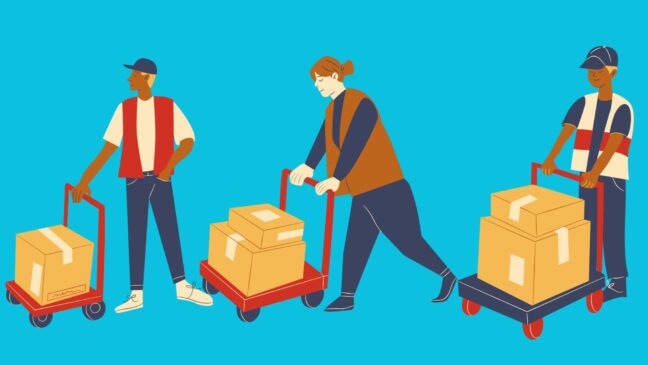
These include premium trolleys, roll cages, pallets, post-pallet stillages, and pallet converters from a reputable ergonomic material handling equipment company. The equipment comes fitted with wheels, a handle, and a platform where items are placed to be moved.
Once placed, the roll cage, trolley, or pallet can be pushed from point A to B. This is useful ergonomically because the person moving items doesn’t need to haunch awkwardly under the weight of the items in transit. Additionally, they do not absorb the entire weight of the item being carried, which can be strenuous on the arms, shoulders, neck, knees, and back.
Lastly, the risk of an item falling while en route and injuring the employee carrying it is entirely eliminated, making it much safer to haul bulky items.
Lifting Equipment
Unfortunately, completing tasks that involve heavy lifting, bending, twisting, repetitive stress, and pushing and pulling increases one’s risk for lower back pain.
One way to circumvent this is to use lifting equipment. These include cranes, ergonomic box lifters, pallet lifters, manipulator arms, forklifts, vacuum lifters, hydraulic lift tables, and the like.
Lifting equipment absorbs almost all your employees’ manual handling, but it must be adequately operated to work efficiently and safely.
Manual Lifting and Handling
Handling means workers use their hands to lower, lift, move, and lift empty boxes, loads, containers, and so on.
Some businesses might not have loads large enough to justify the purchase of heavy-duty lifting equipment. For these, manual lifting and handling might be required.
How do you employ ergonomics during manual lifting? Here are some pointers.
Continuous Training
Like other safety measures in the workplace, employee buy-in is crucial. One way to harness this is by ensuring proper lifting safety training for employees. By educating workers on potential risks and the importance of safe lifting techniques, companies in warehousing, logistics, and construction can significantly reduce injuries.
Training must be part of the onboarding process and should ideally be a continuous process for business.
Maintaining Proper Posture
There is a proper form for lifting items off the ground. Here is a snapshot of the appropriate procedure when lifting loads:
- Avoid reaching by getting as close to the object as possible
- Keep your arms and elbows as close to your body as possible
- Hold your feet shoulder-length apart and one foot ahead of the other to maintain a broad support base.
- Avoid bending over at the waist to pick things off the ground. Instead, bend at the knees to lower your body in a squat. If you need extra support, you can place one knee on the floor as you squat.
- Look straight ahead, holding your back straight, chest out, and square your shoulders back. This will help you keep a straight back and a slight arch in your lower back.
- Lift the load slowly, as opposed to jerking. Do this by straightening your knees and hips instead of your back. Be keen to lift your body upwards and steadily without twisting.
- Again, set the load down by bending at the knees to assume a squatting position.
- As a rule, never hold a load with extended arms. Similarly, avoid lifting heavy loads above your shoulders.
Appropriate PPE Provision
Dressing appropriately for manual handling can help avert unpleasant incidents. Employers should consider providing:
- Anti-slip gloves
- Steel toed, rubber-soled boots
- Loose-fitting overalls that allow flexibility when bending
- Lifting belts to support the core and protect against back injuries
Are You Looking for Improved Handling and Lifting Safety?
At Rollcage, we recognize that not every business needs heavy-duty equipment. Smaller enterprises can immensely benefit from smaller, affordable ergonomic handling equipment that’s tailor-made to manage their operations.
If you’re looking for customizable options that meet your business needs, contact us today for ergonomic equipment solutions to ensure improved safety in your operations.